
One binary for AI everywhere you work:
the terminal, your editor, your chat apps and webhooks, a gRPC server and Kubernetes.
14 LLM providers · an autonomous coder agent · a seven-pattern quality harness
Mixture-of-Agents with cross-review · a live APM-style dashboard
https://chatcli.edilsonfreitas.com
The official website: guides, cookbooks, configuration and the full reference for every feature, in English and Portuguese.








Documentation · Quick start · Highlights · Security · Contributing · Português
- Every major model, one interface. Switch provider or model mid-conversation; fail over automatically; keep cost, tokens and prompt-cache use in view.
- An agent that does the work.
/coderreads, edits, runs and tests code under a security policy you control, with checkpoints you can rewind. - Answers you can trust more. Self-Refine, Chain-of-Verification, Reflexion, RAG with HyDE and Mixture-of-Agents with cross-review cross-check what models say.
- The same brain everywhere. The terminal, a browser UI, editors over ACP, any MCP client, Telegram, Slack, Discord, WhatsApp, webhooks, a gRPC server and a Kubernetes operator share sessions, memory and tools.
- Built to run where it matters. Signed releases, fail-closed defaults, workspace trust, audit logs and a published security process.
# Homebrew (macOS, Linux)
brew tap diillson/chatcli && brew install chatcli

# or Go
go install github.com/diillson/chatcli@latest

# or a signed binary from the releases page
# https://github.com/diillson/chatcli/releases/latest
Point it at a model, with an API key or an OAuth login:
export LLM_PROVIDER=OPENAI OPENAI_API_KEY=sk-...   # or CLAUDEAI, GOOGLEAI, BEDROCK, XAI, OLLAMA, …
chatcli                                            # then /auth login <provider> for OAuth
Then:
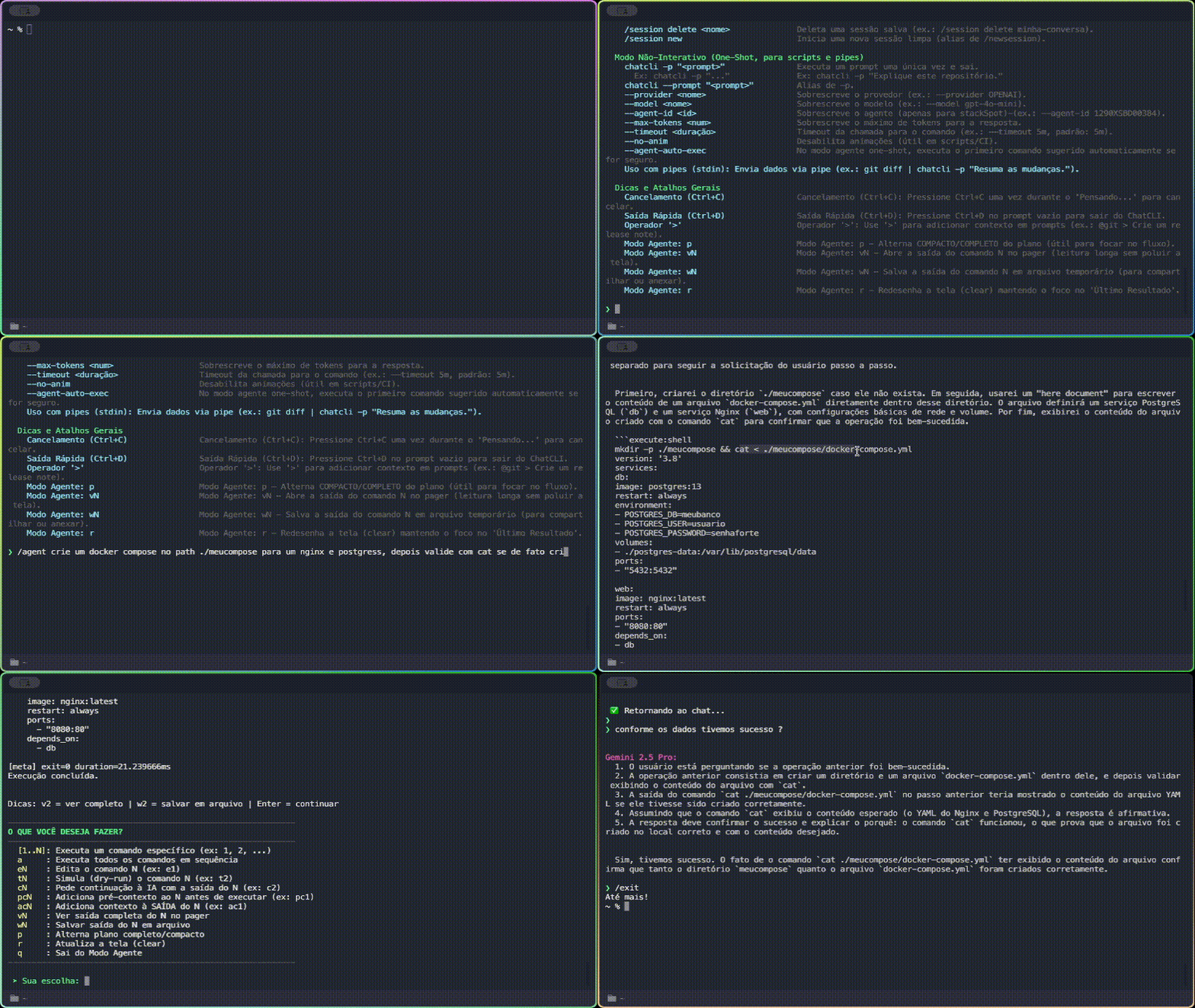
chatcli -p "Explain this repository"               # one-shot, pipeable
git diff | chatcli -p "Write the commit message"
chatcli                                            # interactive
  > /coder add tests for the utils package         # the autonomous coder
  > /moa --layers 2 Should we migrate to Karpenter? # several models, cross-reviewed
  > /dash                                          # watch everything live
ChatCLI keeps itself current with /update (Homebrew, go install or a signature-verified self-replace). Installation guide →
|
A ReAct loop with 46 builtin tools: files, search, shell, git, tests, LSP diagnostics, a real browser, Git forges, background processes. Every call goes through an allow/ask/deny policy; edits are checkpointed in a shadow repository; an optional OS sandbox confines commands. Coder mode → |
|
|
Seven patterns, composable and observable: ReAct, Plan-and-Solve, Reflexion with a durable queue, RAG + HyDE, Self-Refine with semantic convergence, Chain-of-Verification and a cross-provider reasoning backbone. Harness → |
|
|
Specialist workers run in parallel under a dispatcher; |
An MCP client (stdio, SSE, HTTP with OAuth) and an MCP server that re-exports everything; an ACP server for editors; signed plugins; provider plugins that add a whole LLM provider; skills from several registries; slash commands compatible with nine other CLIs. Extensions → |
|
Telegram, Slack, Discord, WhatsApp and webhooks run the same agent, with voice notes transcribed offline and answered in voice, sender allowlists that fail closed and one conversation across channels. Gateway → |
A gRPC server with TLS 1.3, JWT and roles, and an operator with 17 CRDs that watches workloads, opens incidents, proposes and applies remediations behind approvals, and writes post-mortems. Kubernetes → |
|
PDFs and images reach every model, natively where it can read them and as text where it cannot; image generation, offline speech-to-text and text-to-speech, diagrams and an interactive knowledge graph. PDF input → |
Long-term memory with a profile and facts, a knowledge base with keyless BM25 retrieval, reversible compression where nothing is lost ( |
|
Durable jobs with cron, wait-until conditions and dependencies; a daemon keeps them running with the terminal closed; agents can park themselves and wake on a condition. Scheduler → |
|
| Surface | Start it with | |
|---|---|---|
| Interactive terminal | chatcli |
chat, /coder, /agent, /moa, every slash command |
| One-shot and pipes | chatcli -p "…" |
scripts, CI, git diff | chatcli -p … |
| Browser UI | /web or chatcli web |
the same session as the terminal |
| Editors (ACP) | chatcli acp |
Zed and other ACP clients |
| Any MCP client | chatcli mcp-server |
every tool, the agent loops, skills as prompts |
| Chat apps | /gateway start |
Telegram, Slack, Discord, WhatsApp, webhooks |
| Shared backend | chatcli server |
gRPC with TLS 1.3, JWT and roles |
| Kubernetes | Helm chart chatcli-operator |
AIOps operator |
| Live dashboard | /dash or chatcli dash |
every ChatCLI process on the machine |
14 built-in providers behind one interface, with a fallback chain, cross-provider reasoning control (/thinking) and prompt caching where the provider offers it. Provider plugins add more without rebuilding ChatCLI.
| Provider | LLM_PROVIDER |
Auth |
|---|---|---|
| OpenAI | OPENAI |
OPENAI_API_KEY, or OAuth with /auth login openai-codex (Responses API) |
| OpenAI Assistants | OPENAI_ASSISTANT |
OPENAI_API_KEY |
| Anthropic Claude | CLAUDEAI |
ANTHROPIC_API_KEY, or OAuth with /auth login anthropic |
| AWS Bedrock | BEDROCK |
AWS profile, SSO, aws login or the credentials chain |
| Google Gemini | GOOGLEAI |
GOOGLEAI_API_KEY |
| xAI Grok | XAI |
XAI_API_KEY |
| Z.AI (GLM) | ZAI |
ZAI_API_KEY, including the GLM Coding Plan |
| Moonshot Kimi | MOONSHOT |
MOONSHOT_API_KEY |
| MiniMax | MINIMAX |
MINIMAX_API_KEY |
| OpenRouter | OPENROUTER |
OPENROUTER_API_KEY |
| GitHub Copilot | COPILOT |
/auth login github-copilot (device flow) or GITHUB_COPILOT_TOKEN |
| Ollama | OLLAMA |
local, no key |
| StackSpot AI | STACKSPOT |
CLIENT_ID and CLIENT_KEY |
| Devin (Cognition) | DEVIN |
the local Devin CLI |
Models, prices and context windows come from a live catalog: /switch --model lists what each account really serves. Supported models → · All settings →
ChatCLI runs commands and holds credentials, so security is the default, not an option:
- Policy-gated tools: every agent action is allowed, asked or denied by a policy you control; unattended surfaces refuse instead of approving.
- Workspace trust: a project's
.env, hooks and policy load only afterchatcli trust. - Fail-closed integrations: chat channels refuse to start without a sender allowlist; signed webhooks are verified with HMAC.
- Encrypted at rest by default: conversations, memory, contexts, attachments and credentials are sealed with AES-256-GCM, with the key in the OS keychain (macOS, Linux, Windows) or, in Kubernetes, in a Secret; OAuth uses PKCE. Save a recovery key with
/config security recovery-key: without it, a lost keychain means the data cannot be opened. - No telemetry: your data goes only to the providers and tools you configure; metrics leave the machine only if you point OTLP at your own collector.
- Signed supply chain: Ed25519-signed release checksums verified by
chatcli update, Cosign-signed images, an SBOM, and Trivy, CodeQL, gosec and govulncheck on every change.
Report vulnerabilities privately: see SECURITY.md. What happens to your data → · Security overview →
| Get started | Installation · Quickstart · Basic usage |
| Agents | Coder mode · Squads · Task graph · Mixture-of-Agents · Harness |
| Context | Memory · Knowledge base · Compression · Sessions |
| Extend | Plugins · Provider plugins · MCP · Skills · Hooks · Slash commands |
| Run it | Server mode · Gateway · Kubernetes operator · Docker |
| Reference | Commands · Environment variables · Architecture · Releases |
- Contribute: read CONTRIBUTING.md for the setup, the conventions and what CI checks.
- Conduct: everyone taking part follows the Code of Conduct.
- Security: report vulnerabilities privately as described in SECURITY.md.
- Bugs and ideas: open an issue.
If ChatCLI is useful to you, a ⭐ helps others find it.
Apache License 2.0 © Edilson Freitas