
Run zod schemas on the ata engine. The schema stays zod. The verdict comes from compiled JSON Schema validation where that is provably safe, and from zod itself everywhere it is not.
npm i @ata-project/zodzod 4 and ata-validator are peer dependencies; npm and pnpm install them automatically, yarn users add them alongside.
import { z } from 'zod'
import { compile } from '@ata-project/zod'

const user = z.object({
  id: z.number().int().min(1),
  name: z.string().min(1).max(64),
  email: z.string().email(),
})

const check = compile(user)

check.isValid(data)      // boolean, ata answers
check.safeParse(data)    // zod-shaped result, the value zod would return
check.parse(data)        // throws a real ZodError
Types carry through: safeParse returns z.output of your schema.
zod 4 turns a schema into JSON Schema with z.toJSONSchema, and ata executes
JSON Schema. That conversion is lossy in both directions: refinements and
transforms are dropped silently, which makes the emitted schema looser than
zod, and coercion is dropped too, which makes it stricter. A wrong answer in
either direction is unacceptable, so compile classifies the schema by
walking zod's own definition tree before anything runs:
| Mode | When | Who answers |
|---|---|---|
ata |
the conversion is exact | ata alone |
hybrid |
refine, transform, pipe, Date and other non-JSON types | ata's rejection is final; an acceptance runs zod for the residue |
zod |
coerce, catch, preprocess, or a node this package does not recognise | zod, undecorated |
The classification is conservative: an unrecognised node lands in zod mode,
so a new zod feature can make this package slower, never wrong. The test suite
holds isValid, safeParse and the parsed value against zod itself over
15,000 generated values across all three modes, including recursive schemas,
and runs the whole suite a second time with code generation blocked.
compiled.engine tells you which mode you got, compiled.reasons says why.
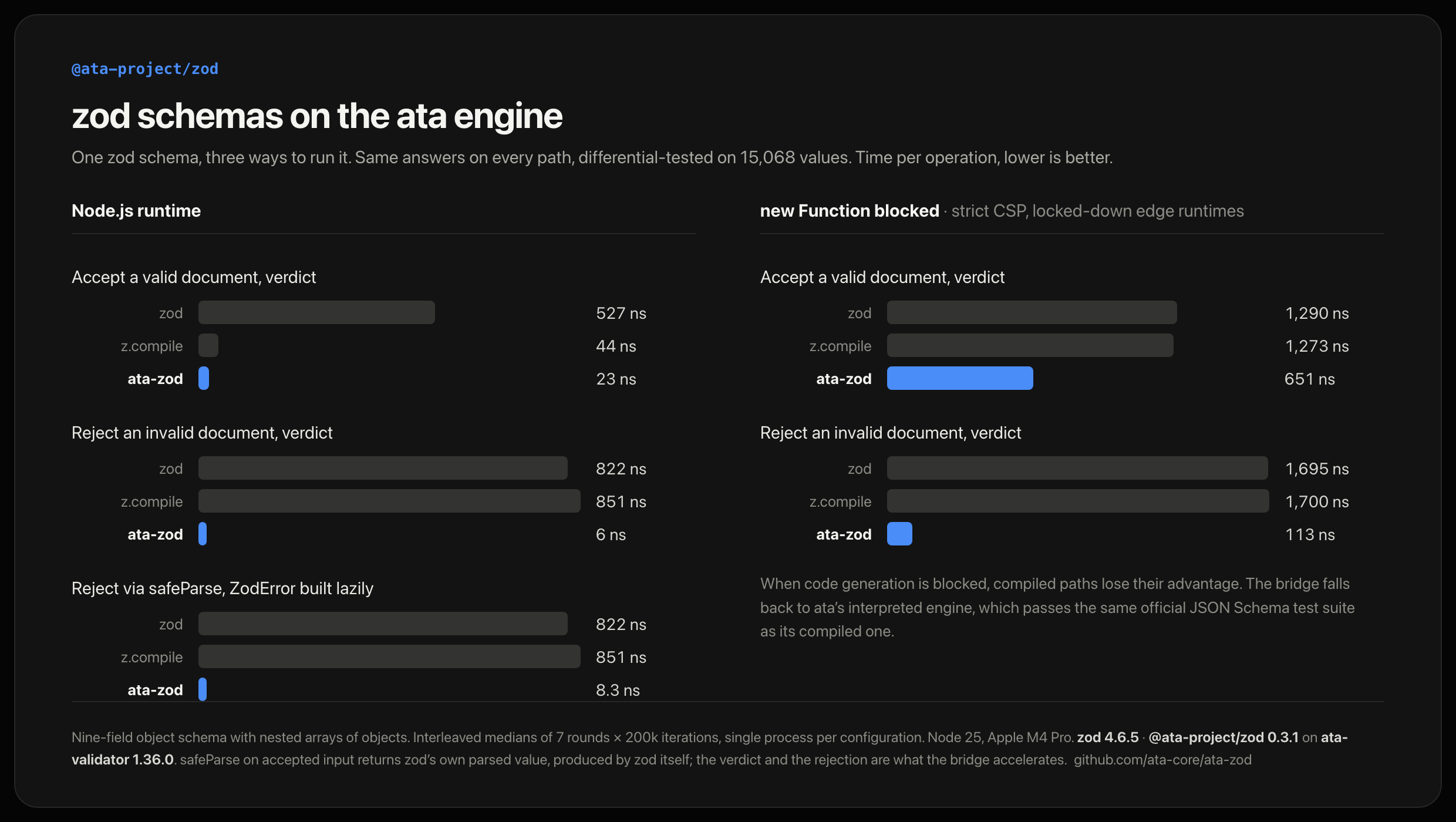
One representative API-boundary object schema (nine fields, nested arrays of objects, enum, union), interleaved medians of 7 rounds on an M-series Mac, Node 25, zod 4.6.5, @ata-project/zod 0.3.1, ata-validator 1.63.1, median of three runs on 2026-11-06:
zod safeParse |
z.compile |
this package | |
|---|---|---|---|
| accept, verdict only | 538 ns | 48 ns | 21.4 ns |
| reject, verdict only | 838 ns | 844 ns | 5.9 ns |
reject, safeParse |
838 ns | 844 ns | 7.6 ns |
accept, safeParse |
538 ns | 48 ns | 46.8 ns |
An accepted value is built by ata's parse() wherever the classifier proves
it comes out exactly as zod would build it: plain objects whose optional keys
follow the required ones, arrays, primitives and unions of primitives, with
nothing that fills a default, rewrites a value or keeps undeclared keys. The
differential suite holds that value to zod's, key order included. Anything
else, a default, a transform, a record, a union of objects, a loose object,
hands the accepted value to zod, which returns exactly what it always did.
This needs ata-validator 1.33.0 or later, which copies arrays instead of
sharing them with the input; with an older ata every accepted value goes to
zod. isValid never runs zod in ata mode, and a rejected safeParse builds
its ZodError only when somebody reads it, by running zod once at that moment.
With code generation blocked, the way a strict CSP or a locked-down edge
runtime blocks it (node --disallow-code-generation-from-strings):
zod safeParse |
z.compile |
this package | |
|---|---|---|---|
| accept, verdict only | 1290 ns | 1273 ns | 651 ns |
| reject, verdict only | 1695 ns | 1700 ns | 113 ns |
z.compile does not fail there, but its advantage does: it runs at the speed
of uncompiled zod. ata falls back to its interpreted engine, which passes the
same official JSON Schema test suite as its compiled one.
This package runs zod's schema on ata's engine at runtime, so the page carries
both. A page that only needs the verdict can drop both: the zod option of
@ata-project/unplugin
(0.13.0, in Vite, Webpack, Rollup, Rolldown, esbuild, Rspack and Bun) loads
the modules that export your zod 4 schemas at build time, converts each with
z.toJSONSchema and writes a compiled { validate, isValidObject } beside
the module, typed as z.input<...>. Measured on three event schemas,
esbuild minified and gzipped, ata-validator 1.63.1 and zod 4.6.7: the page
carries 3.9 KB with the compiled validators and 93.0 KB with zod. A
.refine or .transform that reads only its own parameter is carried;
one that closes over an outside name, a superRefine or a preprocess
stops the build by export and path rather than being dropped.
isValidBytes answers from a Buffer, Uint8Array or JSON string without
JSON.parse and without materializing a JavaScript object, something zod has
no path for at all:
const check = compile(schema)
check.isValidBytes(request.rawBody)   // boolean, straight from the bytes
On an engine: 'ata' schema with the native engine present, the verdict comes
from a SIMD walk of the buffer. The same array-of-objects schema as above,
interleaved medians of 7 rounds, first element invalid on the reject rows,
measured on zod 4.5.4 and ata-validator 1.13.1:
| payload | zod parse + safeParse | isValidBytes |
|---|---|---|
| 0.2 KB, accept | 0.9 us | 0.6 us |
| 0.2 KB, reject | 1.6 us | 0.6 us |
| 22.7 KB, accept | 79.2 us | 47.6 us |
| 22.7 KB, reject | 81.0 us | 45.6 us |
| 229 KB, accept | 793 us | 489 us |
| 229 KB, reject | 791 us | 482 us |
Bytes that are not valid JSON return false rather than throwing. The verdict
agrees with safeParse on the parsed value; the differential suite compares
the two on every JSON-representable value it generates.
Plainly: this is a verdict, not a parse. When you need the value, you still
parse and safeParse it, and hybrid and zod mode schemas, and installs
without the native engine, do exactly that under the hood. The API is worth
having where rejection is the common case: gateways, webhook endpoints and
queue consumers that drop bad messages before doing any further work.
- Accepted values in
hybridmode, accepted values whose shape ata cannot build exactly as zod does, and every value inzodmode run zod, so those paths are zod-speed. - Value-rewriting checks such as
.trim()and.toLowerCase()put a schema inzodmode. They do not reach the JSON Schema, and they can make zod accept what the schema rejects as well as the other way round. 0.2.1 and earlier missed them and could answerisValidwrongly; upgrade if you use them. validate()reports ata's errors for the schema-representable part, which are JSON Schema errors, notZodErrorissues. UsesafeParsewhen you need zod's error shape.- The classifier reads
schema._zod.def, which is zod's internal tree. The peer range is pinned to zod 4 and the differential suite is the tripwire for internals moving. - Async refinements are not supported;
safeParseis synchronous, as in zod.
The compiled object implements Standard Schema V1, so anything that accepts a standard schema runs the fast path without knowing either library:
const result = check['~standard'].validate(data)MIT